Since late last week, the Chinese steel market has posted a sharp drop, following rapid declines in futures and iron ore prices. What is driving such a negative trend in China in April, which is usually one of the best months for consumption and prices due to higher construction activity? SteelOrbis has also surveyed market sources’ expectations for May.
Steel prices in China fall to the lowest level in four months
According to information from the market, rebar and HRC spot prices in China are respectively down sharply to RMB 3,877/mt ex-warehouse and RMB 4,145/mt ex-warehouse on April 24, dropping by RMB 106/mt ($15/mt) and RMB 65/mt ($9/mt) since last Friday, falling to the lowest levels since the middle of December 2022. The uptrend seen for most of the first quarter was expected, but the situation in April is a more surprising development for most market sources, as usually construction steel demand is strongest in the April-May and September-October periods. But this year, even though the local market has posted a gradual improvement in consumption, this has been insufficient to prevent prices from recording significant declines due to supply pressure. “If we compare March and April, I would say demand is still there. It is not lower, and we saw normal inventory movements. The main reason [for the recent drop in steel prices] is iron ore. And supply [of steel] was high. The international market did not provide much support,” a Chinese mill said.
Steel export prices from China have also been dropping continuously. The SteelOrbis daily reference tradable SS400 HRC price from China has come to $555-570/mt FOB on April 24, with the midpoint at $562.5/mt FOB, down by $32.5/mt since late last week. Prices at $570/mt FOB and below were last seen in early December 2022. “We needed to sell, but demand was going down in the international market as buyers were becoming more and more cautious,” an exporter of HRC said.
Ex-China rebar offers from mills have slipped to $540-550/mt FOB, losing $20/mt since last Friday. Rebar futures closed at RMB 3,714/mt ($540/mt) at Shanghai Futures Exchange, decreasing by RMB 214/mt ($31.1/mt) or 5.45 percent compared to April 17, while down by 3.61 percent compared to the previous trading day. “Futures are falling when sentiments are weak. This we have already been seeing for some time. Mills’ margins are under big pressure,” a trader said.
“The weather was rainy in April, but of course this is not the main thing,” another source said.
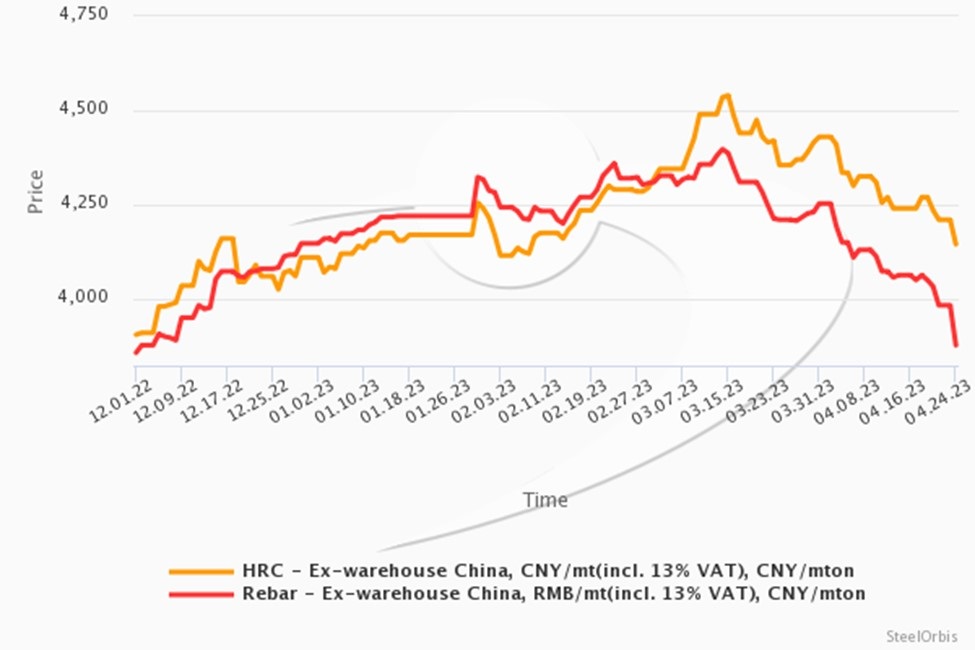
Iron ore as the main driver of the downtrend
This time, the main reason for the downtrend in China is iron ore, most market sources agree. And the imbalance in iron ore supply and demand has been behind the drop in prices.
In the January-March period this year, China’s crude steel output amounted to 261.56 million mt, increasing by 6.1 percent year on year, as announced by China's National Bureau of Statistics (NBS). And in the first half of April, production has remained strong, but starting from middle of April, when the impact of supplies had accumulated and mills started to suffer from lower margins, output cuts have begun to be implemented, which has significantly curbed iron ore demand. According to ANZ commodity strategists, over 40 percent of BFs in Tangshan started maintenance works in the second half of April. “This [production cuts] has already started. I think prices [for iron ore and steel as a result] will keep going down,” a Shanghai-based source said.
The iron ore Fe 62 percent price dropped by $4.6/mt on April 24 compared to the previous day, after a slump by $6.5/mt on Friday, coming to $107/mt CFR, according to SteelOrbis’ data. The last time iron ore was at this level was back in early December and a number of sources believe that the government’s calls to control iron ore prices have also been an important factor.
Though steel production has started to go down, this has not supported steel prices, at least so far, as the “iron ore impact” is much stronger at the moment, sources believe.
Most major analysts believe iron ore prices will fluctuate at a lower level in the second half of the year compared to the first half, since, according to unofficial information, China has plans to cut overall output by 1-2.5 percent in 2023, which would impact demand for iron ore. According to different banks, iron ore prices may decline to $90-100/mt on average in the second half, having fluctuated mainly at above $120/mt in the first quarter.
May expected to be better, but not as much as usual
Most market sources believe that for now steel prices still have some room to go down and lower raw material prices may help mills to avoid recording higher losses. “Until the end of April, prices will definitely fall, but what can we expect for May? I would say stability should come with lower production,” a source commented.
Some other market sources even expect some rebound in the second half of May with more demand after the holidays, but most of them are very cautious. “If margins improve, mills will cover demand more actively, but this may again result in higher production,” a source said, adding that the recent steel output cuts have not been mandatory government cuts, but resulted from low to zero profits.
According to Zhang Qiusheng, chief analyst and senior engineer at Jiangsu Province-based Chinese steelmaker Nanjing Iron & Steel Co. the average steel prices have seen their peak level in March, and another peak will be seen in November-December amid expected steel production restriction measures imposed by the government.
$1 = RMB 6.8835