At the second session of the 20th SteelOrbis “New Horizons in Steel Markets” Conference held on Tuesday, December 9, in Istanbul, during a panel discussion moderated by Ayça Özbay, global ferrous scrap market analyst at SteelOrbis, the panelists commented on the current situation in the scrap market and the possible risks it faces.
Assessing the supply and demand situation in the US scrap market following Trump’s tariffs, Tao Bai, commercial general manager of EMR Group, noted that the increase in US tariffs has boosted capacity utilization, scrap demand and purchasing power in the country. Noting that there has been a significant slowdown in the US manufacturing industry amid the uncertainty surrounding the market due to the tariffs, he stated that this slowdown has led to weak scrap generation. However, he commented that the overall fundamentals of US scrap supply have not changed much as the US is self-sufficient in scrap. Mr. Bai added that, although US scrap suppliers seem to be focusing on their domestic market given its advantageous prices, scrap exports will hardly be limited as no scrap shortage is expected in the country in the long term.
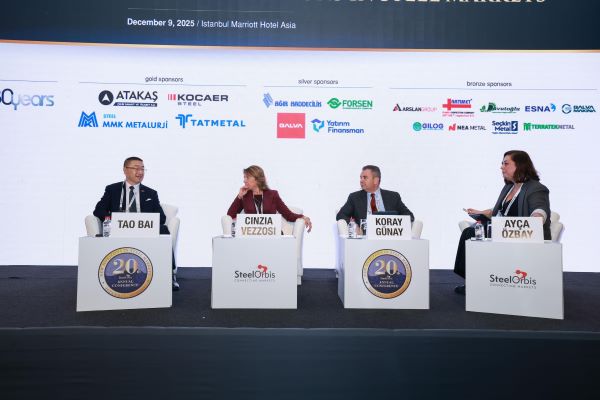
Regarding the impact of the Carbon Border Adjustment Mechanism (CBAM) on the scrap market, Cinzia Vezzosi, president of Italy’s Assofermet, vice president of Recycling Europe (EuRic), and owner and managing director of Zetamet, stated that scrap prices in the EU have recently increased by €5-10/mt, especially for high qualities. She said that the price rise is not directly linked to CBAM, but to restocking due to the approaching Christmas break. Evaluating CBAM as “a sort of a nightmare”, she stated that traders in the EU are trying to purchase material before the end of the year to avoid CBAM-related costs. Noting that, similar to the US, the demand from the EU manufacturing industry is very low, she stated that this has led to a reduction in steel production, and consequently lower scrap demand. She went on to state that scrap demand may recover in the first quarter of 2026. Regarding the rumors of an export ban for scrap in the EU, she stated that there is no scrap export ban in the EU yet. Pointing out that the EU collects 100 million mt of scrap and only uses 80 million mt of this, leaving the rest as a surplus, Mrs. Vezzosi, added that, if a ban is imposed, it will most probably lead to the closure of many recycling companies, and it would also be challenging for the EU to keep Turkey, the world’s leading scrap importer, as an economic ally.
Commenting on the effect of CBAM on the demand for scrap, Koray Günay, purchasing director of Turkish steelmaker Çolakoğlu Metalurji, said that CBAM’s effect on scrap demand will not be dramatical in the short term, despite the expectations of a significant increase. Meanwhile, in the long run, he said he anticipates that scrap demand will rise with the transition to electric arc furnace steelmaking replacing the blast furnace route. Regarding potential scrap export limitations in the EU, Mr. Günay noted that, as Turkey is a major regional partner for the EU as well as an OECD country, Turkey will not be first on the list of those that will be affected by any limitation. As regards domestic scrap capacity in Turkey, he said he expects that, if the construction industry in Turkey is boosted by an economic recovery in the coming years, it will lead to more scrap availability in the country.