Global DRI output up 8.6 percent in August 2025

Thursday, 25 September 2025 13:37:15 (GMT+3)   |   Istanbul

According to the data released by the World Steel Association (worldsteel), global direct reduced iron (DRI) production in the 12 countries accounting for approximately 85 percent of total world DRI production in 2024 amounted to 10.86 million metric tons in August this year, decreasing by 0.9 percent month on month and up by 8.6 percent year on year.

Meanwhile, world DRI output came to 84.44 million metric tons in the first eight months of this year, up by 5.3 percent compared to the corresponding period of 2024.

The worldsteel data show that India was the largest DRI producer among the countries surveyed in August this year, with its DRI output amounting to 4.95 million metric tons in the given month. India was followed by Iran, Russia and Saudi Arabia in August, with outputs of 3.18 million mt, 650,000 mt and 613,000 mt respectively.

Shares in global DRI production - August 2025
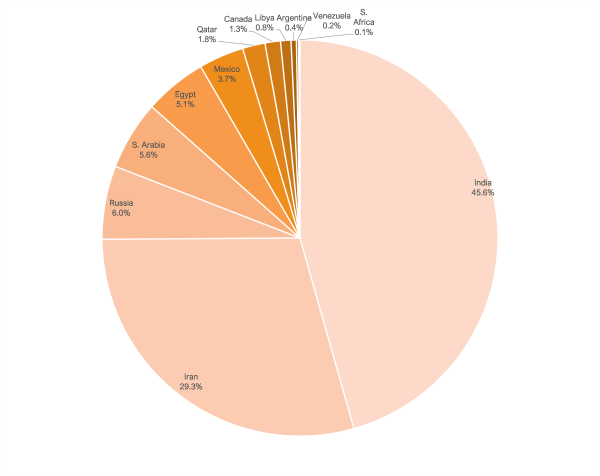
Shares in global DRI production - August 2025

BoraKadıoğlu
Bora Kadıoğlu
Editor

I graduated from Boğaziçi University with a degree in Translation and Interpreting Studies. I have been working in the iron and steel sector for three years as a content specialist at SteelOrbis, mainly focusing on plant investments, steelmaking technology, and import/export statistics.

Similar articles

Global DRI output down 7.6 percent in June 2026

World crude steel output up 1.7 percent in June 2026

BIR: Global scrap market remains volatile as Turkish demand weakens

Global DRI output down 17.5 percent in May 2026

World crude steel output down 0.3 percent in May 2026

US import long steel prices flat, Iran deal signals cautious optimism for shippers

Fitch raises iron ore and coking coal price forecasts amid supply disruptions and higher costs

Vale sees strong long-term iron ore demand despite China reaching steel production plateau

BIR: Recycled steel to become strategic foundation of the future steel industry

BIR: Global recycled steel consumption rises despite lower crude steel output in 2025