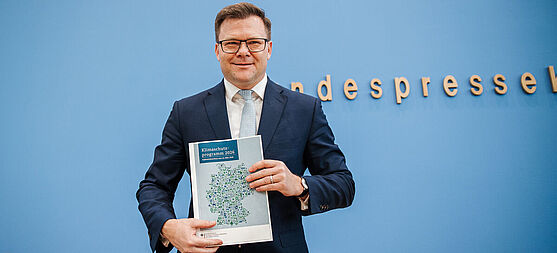
The German government has announced that it has adopted its 2026 climate protection program, marking a further step toward achieving greenhouse gas neutrality by 2045.
The program, approved by the cabinet, will now be reviewed by the Council of Experts on Climate Issues before implementation. The measures are designed to align with legally binding climate targets and support emissions reductions by 2030 and 2040.
€2.9 billion support for industrial decarbonization
A key pillar of the program is the allocation of approximately €2.9 billion to the industrial sector.
The funding will support electrification of industrial processes, decarbonization of process heat and the development of circular economy solutions. Electrification is expected to reduce emissions while improving long-term energy efficiency and lowering dependence on natural gas imports.
According to government estimates, these measures could cut carbon emissions by at least 4.3 million mt by 2030 and reduce natural gas imports by around 2.5 billion cubic meters.
Renewable expansion and green lead markets
The program also includes accelerated expansion of renewable energy capacity, particularly an additional 12 GW of onshore wind. This expansion is expected to reduce reliance on fossil fuels and cut carbon emissions by around 6.5 million mt by 2030.
In addition, the government has introduced the concept of green lead markets for the first time, aiming to stimulate demand for low-carbon materials such as climate-friendly steel and cement, particularly through public procurement and the automotive sector.
Steel sector calls for stronger implementation
German Steel Federation (WV Stahl) CEO Kerstin Maria Rippel stated that the program provides a comprehensive framework for achieving climate targets but emphasized that its success will depend on effective implementation. She welcomed the inclusion of lead markets for low-carbon steel, noting that stable and predictable demand is essential for scaling up production. However, Rippel criticized the absence of concrete measures in the rail sector, describing it as a missed opportunity given its importance for industrial decarbonization.
She also stressed that the design of lead markets will be critical, particularly in upcoming legislation such as the Public Procurement Acceleration Act. According to her, without a “Made in Europe” criterion, public funding could support decarbonization outside Europe, weakening domestic industry.
WV Stahl emphasized that Europe must create strong lead markets specifically for low-emission steel produced within the EU. Rippel concluded that climate policy and industrial competitiveness must be addressed together, warning that only a balanced approach can ensure both successful decarbonization and the preservation of Europe’s industrial base.