Italian steelmaker Feralpi Group increased production, revenue and profitability in 2025 while completing a three-year investment programme worth more than €500 million, positioning the company to benefit from future market opportunities despite the challenging outlook for the European steel industry.
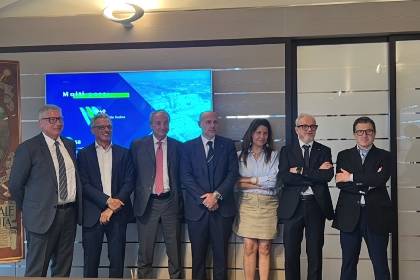
The results were presented on July 15 at the company’s headquarters in Lonato del Garda, northern Italy, where management outlined the completion of one of the group’s most significant industrial transformation programmes in recent years. The event also featured a market outlook by commodity analyst Gianclaudio Torlizzi, founder of T-Commodity and advisor to the Italian defence minister on strategic raw materials.
Although Feralpi reported stronger financial and operational performance, executives stressed that European steelmakers continue to face weak demand, high energy costs, mounting import pressure and persistent geopolitical uncertainty.
Production and profitability improve
Feralpi produced 2.7 million mt of crude steel in 2025, up 4.7 percent year on year, while consolidated revenue increased by three percent to €1.7 billion. EBITDA rose to €87.2 million, and the group returned to a marginal net profit of €401,000, following a loss in the previous financial year.
Depreciation and impairment charges remained significant at €71.6 million, reflecting the substantial investments completed over the past three years. Net financial debt increased to €196.9 million from €155.5 million, mainly due to capital expenditure, only partly offset by lower working capital requirements.
International operations continued to play a key role, with 61 percent of total revenue generated outside Italy. The group currently operates across seven countries, serving the construction steel, special steel and energy sectors.
“We have now achieved the industrial configuration we set out to build,” Feralpi president Giuseppe Pasini said, describing the company’s outlook as one of “cautious but solid optimism.” According to Pasini, the completion of the investment programme provides the industrial platform needed to seize future opportunities, particularly as demand for lower-carbon steel products grows.
€500 million investment programme completed
The completion of Feralpi’s investment cycle marks the beginning of a new phase focused on maximising returns from its upgraded production base.
Between 2023 and 2025, the company invested more than €500 million, including €115.7 million during the latest financial year alone. More than 80 percent of 2025 investments were allocated to environmental, social and governance (ESG)-related projects, while also improving production efficiency, digitalisation and operational safety.
Among the flagship projects is the new rolling mill at Feralpi Stahl in Riesa, Germany, designed to produce coils weighing up to eight metric tons without direct emissions during the rolling process.
At its Lonato plant, the group commissioned an electrically powered billet heating system aimed at reducing natural gas consumption and direct CO₂ emissions. Artificial intelligence has also been introduced across several facilities to improve scrap recognition, material handling and predictive process control.
European steel remains under pressure
Feralpi’s results come against a mixed backdrop for the global steel industry. Global crude steel production declined by two percent in 2025 to around 1.8 billion mt, while European output fell 2.6 percent. Germany experienced one of the sharpest declines, with production dropping 8.6 percent to 34.1 million mt.
Italy, however, outperformed the broader European market, increasing crude steel production by 3.6 percent to 20.7 million mt, although national output remains more than 15 percent below 2021 levels.
Despite this recovery, structural challenges persist across Europe. Steelmakers continue to struggle with subdued demand, significantly higher energy costs than many international competitors and increasing pressure from imports, not only of steel products but also of steel-intensive manufactured goods.
Supply chain security becoming the new priority
Speaking during the conference, commodity analyst Gianclaudio Torlizzi argued that the pandemic, the war in Ukraine and tensions in the Middle East should not be viewed as isolated crises but as part of a broader transformation of the global economic model.
According to Torlizzi, companies and governments are shifting from “just-in-time” supply chains towards “just-in-case” strategies that prioritise resilience through higher inventories, supplier diversification and greater production redundancy. In this environment, supply security, energy availability and access to strategic raw materials have become as important as economic efficiency.
Torlizzi also warned that while measures such as the EU’s Carbon Border Adjustment Mechanism (CBAM) and safeguard measures provide some protection for European steel producers, they may prove insufficient if they do not also address downstream products.
“If Europe protects steel but not downstream manufacturing, the problem simply moves elsewhere,” he said, arguing that industrial policy should strengthen entire value chains rather than focusing solely on primary steel production.
Scrap increasingly viewed as a strategic raw material
The conference also highlighted the growing strategic importance of ferrous scrap, a key feedstock for electric arc furnace (EAF) steelmaking and one of the pillars of Europe’s decarbonisation strategy. Rising exports of European scrap, particularly to Turkey, have intensified discussions over whether scrap should be treated as a strategic resource within the European Union.
For EAF producers such as Feralpi, ensuring sufficient domestic scrap availability at competitive prices will become increasingly important as demand for low-carbon steel continues to expand.
Beyond its environmental value, scrap is increasingly seen as a critical factor for supply security and for maintaining the competitiveness of European steelmakers against producers operating in regions with structurally lower energy and raw material costs.
Sustainability targets ahead of schedule
Feralpi reported that 56 percent of its electricity consumption in 2025 came from renewable sources, already exceeding its 50 percent target for 2030. The group also announced that its long-term climate targets have been validated by the Science Based Targets initiative (SBTi). By 2050, Feralpi aims to reduce Scope 1, 2 and relevant Scope 3 emissions from its steel operations by 90 percent compared with 2022 levels.
More than 98 percent of the raw materials used in production now come from recycled sources, 93 percent of production residues are recovered, and specific water consumption has been reduced by 36.5 percent since 2022.
With its investment programme now completed, Feralpi’s next challenge will be converting its renewed industrial capacity into sustained profitability. Whether that objective can be achieved will depend not only on market conditions but also on Europe’s ability to develop an industrial policy capable of supporting competitive, low-carbon steel production over the long term.