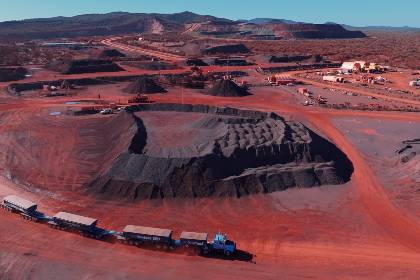
Australia-based miner Fenix Resources has unveiled a three-year production strategy that will significantly expand its iron ore output in Western Australia’s Mid-West, with Weld Range positioned as the company’s new long-term growth anchor. According to Fenix, the plan outlines a phased transition away from the Iron Ridge and Shine mines toward a consolidated production hub at Weld Range, supporting a climb to as much as 6 million mt per year by the financial year 2027-28.
Production to nearly triple from FY 2024-25 levels
Fenix delivered 2.4 million mt of iron ore in the financial year 2024-25 and has now upgraded its guidance for the next financial year to 4.2-4.8 million mt. The company expects output to rise further to 4.7–5.3 million mt in FY 2026-27 and reach 5.4-6.0 million mt in FY 2027-28, driven primarily by the ramp-up of the Beebyn Hub.
Fenix has stated that 100 percent of the approximately 15 million mt planned for extraction over the next three financial years will be sourced from existing ore reserves or measured and indicated Resources, ensuring what it describes as “high confidence” in near-term growth assumptions.
Mining at Iron Ridge is scheduled to conclude in FY 2025-26, with processing of remaining stockpiles extending into the financial year 2026-27. Shine’s Stage 1 plan will also be completed during FY 2025-26, with no Stage 2 tonnages included in the current production outlook.
Weld Range becomes strategic growth platform
A central element of the plan is the Weld Range Project, secured through a 30-year right to mine agreement with Sinosteel Midwest Corporation, a subsidiary of Baowu Group. The agreement gives Fenix access to 290 million mt of resources and obliges the company to target at least 6 million mt per year, with collaborative potential to scale toward 10 million mt.
According to Fenix, operations will increasingly be consolidated at the Beebyn Hub, beginning with the Beebyn-W11 deposit, already in production, and the adjacent Beebyn-W10 deposit, where approvals are expected in FY 2025-26. Annual crushing capacity at the hub is planned to expand from 3 million mt to 5.4-6.0 million mt by FY 2027-28.
Cost stability and capital efficiency
Fenix emphasized that its existing mining, haulage and port infrastructure, comprising its Newhaul Road Logistics fleet, two rail sidings, and more than 400,000 mt of storage capacity at Geraldton, allows the expansion to proceed with relatively modest sustaining capital. Forecast requirements of A$35-45 million over the three-year period are expected to be covered by cash reserves, operational cash flow and existing financing facilities.
The company also noted potential long-term upside beyond FY 2027-28, including a second processing hub at Madoonga, a private haul-road development and transshipment options aimed at reducing logistics costs.
Management outlook
Executive chairman John Welborn said the strategy represents a major step in transforming Fenix into a larger, more resilient iron ore producer. “We delivered on our commitment to triple our production rate in 2025, and we are now focused on increasing our capacity to 6 million mt per year while establishing the foundations for future 10 million mt output,” he stated.