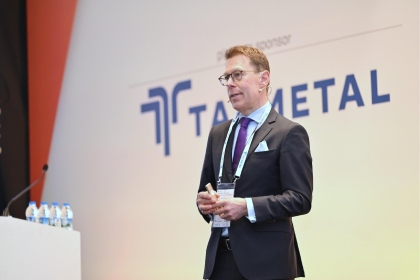
Speaking at the Eurometal Steel Day & YISAD Flat Steel Conference held in Istanbul on March 24, Alexander Julius, president of EUROMETAL, stated that upcoming EU steel trade measures and the Carbon Border Adjustment Mechanism (CBAM) are expected to drive steel prices higher in Europe.
According to Julius, the new EU measures, set to replace existing safeguards after June 30, 2026, and to take effect from July 1, 2026, will significantly restrict supply. The planned halving of import quotas is expected to create a unilateral shortage in the market.
High duties seen as major barrier to trade
Julius emphasized that the 50 percent out-of-quota duty is “non-digestible” for market participants. Once import quotas are exhausted, companies importing steel into the EU, including from Turkey, would be required to pay the full duty, which cannot be absorbed or passed on to customers. He described this as a critical issue for future trade relations, particularly given the quarterly quota system, where importers may face duties early in the period.
CBAM adding cost pressure across value chain
In addition to trade measures, Julius highlighted that CBAM is already contributing to rising steel prices in Europe. He noted that the mechanism increases costs not only for European steel producers but also for importers and end-users, as carbon costs are passed through the value chain. At the same time, uncertainties remain regarding emission calculation methodologies and regulatory definitions, creating additional challenges for market participants.
Steel-based imports raise competitiveness concerns
Julius also pointed to the growing inflow of steel-based products into the EU, which are often not subject to the same duties, carbon costs or safeguard measures. This situation is seen as undermining the competitiveness of European manufacturing, as companies increasingly relocate production outside the EU and re-import finished components. According to industry data, the automotive sector accounts for around 40 percent of such imports.
Turkish exporters face uncertainty
From the perspective of Turkish exporters, Julius noted that uncertainty among EU buyers remains high due to quota limitations and the risk of 50 percent duties. He suggested that an export licensing system aligned with EU quota levels, similar to those used by South Korea and Taiwan, could help stabilize trade flows. Such a system would ensure that exports do not exceed quota volumes, allowing European customers to avoid unexpected duties.
Global protectionism intensifies trade pressure
Julius also highlighted the broader global context, noting that protectionist measures are increasing. The United States has expanded its Section 232 tariffs to include steel-based products with duties of up to 50 percent, with Canada adopting similar measures. These developments are expected to redirect global trade flows toward the EU market, increasing competitive pressure.
Structural shifts in EU steel market
Within Europe, the steel service center sector continues to process around 46 million mt annually, with overall capacity remaining relatively stable.
However, production is increasingly shifting toward higher-value products, while lower-value manufacturing activities are being relocated into the region. Industry consolidation is ongoing, with larger players expanding their market share and investing in advanced processing technologies.
Decarbonization remains key focus
Despite these challenges, decarbonization continues to be a central priority across the steel value chain.
Companies are maintaining investments in emissions reduction, renewable energy and logistics improvements, while demand for low-carbon steel products remains present in certain end-user segments.