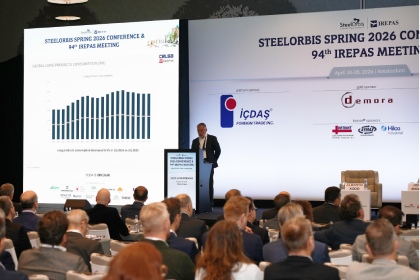
Speaking at the SteelOrbis 2026 Spring Conference & 94th IREPAS Meeting, Alex Gordienko, export director of Spain’s CELSA Group, stated that global GDP growth remains positive but weaker than expected.
According to the International Monetary Fund, he noted, global growth for 2026 has been revised down to 3.1 percent from 3.3 percent, assuming geopolitical tensions ease. For the steel industry, he said that this translates into continued underlying demand but without the strength needed for a meaningful rebound in consumption.
Oversupply persists despite stable demand
Mr. Gordienko stated that demand has proven more resilient than initially feared, yet the market remains oversupplied and highly competitive. This reflects a situation of weak but still positive macroeconomic support rather than a true cyclical recovery, he said, adding that, according to the World Steel Association, global steel demand is expected to grow by just 0.3 percent in 2026.
The CELSA Group official stated that regional dynamics remain uneven, with India and emerging Asia driving growth. India stands out as the strongest market, he noted, with steel demand projected to increase by 7.4 percent, supported by infrastructure investment, which is set to rise by 11.4 percent in the 2026-27 period. Africa is expected to grow by 3.8 percent, while the EU and UK region will see modest growth of 1.3 percent.
Mr. Gordienko went on to say that China continues to weigh on global demand. In the first quarter of 2026, residential floor space sales fell by 13.1 percent year on year, while commercial floor space sales declined by 10.4 percent, reflecting the ongoing weakness in the real estate sector. Overall, Chinese steel demand is expected to decline by 1.5 percent in 2026.
Supply trends show regional divergence
Gordienko pointed out that global crude steel production reached around 1.85 billion mt in 2025, remaining below peak levels. In early 2026, India’s output increased by 10.8 percent, while Germany rose by 9.0 percent from a low base. The US and Turkey recorded moderate growth, whereas China, Brazil, and Russia saw declines. He observed that China’s steel exports exceeded 119 million mt in 2025. Although shipments fell by 9.9 percent year on year in the first quarter of 2026 due to export controls, volumes remain historically high. Any further weakening of domestic demand could quickly push exports higher again.
According to his presentation, long products consumption showed limited weakness, declining by 0.5 percent in the first quarter of 2026 compared to the same period last year. Historical data shows that global long products consumption peaked at over 980 million mt in 2021 and has since followed a gradual downward trend, reaching around 900 million mt in 2026 estimates. A breakdown by product category shows that rebar continue to dominate long products consumption by a significant margin. Rebar consumption reached around 375 million mt in 2025 and projected at approximately 374 million mt in 2026. Wire rod consumption also follows a similar downward trend, decreasing from a peak of nearly 240 million mt in 2020 to around 208 million mt in 2025 and expected to fall slightly further to about 207 million mt in 2026.
Prices stable but margins under pressure
Finished steel prices have remained relatively stable. However, this stability reflects weak pricing power, as mills struggle to pass on volatile input costs such as scrap, freight and energy. As a result, margins remain under pressure despite seemingly acceptable spreads.
Also, a notable shift is the increasing importance of supply certainty. Buyers are prioritizing reliability, availability and execution over price alone, as disruptions in logistics, energy and freight increasingly affect market dynamics.
Strategic shift reshapes steel markets
Gordienko said that the industry is moving from a focus on efficiency toward security. Governments are prioritizing domestic production capacity due to geopolitical risks and supply chain concerns. He pointed out that steel demand is increasingly linked to strategic sectors such as defense, energy and housing, signaling a structural shift in how steel is positioned globally. In this environment, while global oversupply persists, strategically important domestic production is expected to command a premium in the medium term.
Lastly, answering the questions of the audience, Mr. Gordienko stated that, under the EU’s Carbon Border Adjustment Mechanism (CBAM), price volatility is expected to become more limited compared to previous market conditions. By incorporating carbon costs into pricing, CBAM effectively introduces a price floor to the market. In addition, he emphasized that in the medium-term the outlook appears more supportive for Europe as it is currently expanding its defense capabilities, investing in energy infrastructure and capacity, and strengthening its industrial base. These developments are expected to generate additional steel demand over time.