Among the main topics Turkey’s scrap market discussed in 2022 were Russia’s invasion of Ukraine, the sharp rises in energy prices resulting from the invasion, slowing economies all over the world, rising inflation rates, hikes in interest rates in leading economies, declining steel demand, the reduced competitive power of Turkish mills, and shrinking scrap availability towards the end of the year.
Turkey’s overall scrap imports in the January-October period of 2022 totaled 18,292,964 mt, down from 20,412,271 mt in the same period of 2021, while the overall tonnage in 2021 was 25,018,304 of scrap from various destinations. The highest monthly tonnage bought by Turkey in 2022 was recorded in January, with a total of 2,573,567 mt, which was the only month in 2022 that surpassed the previous year in terms of monthly tonnage.
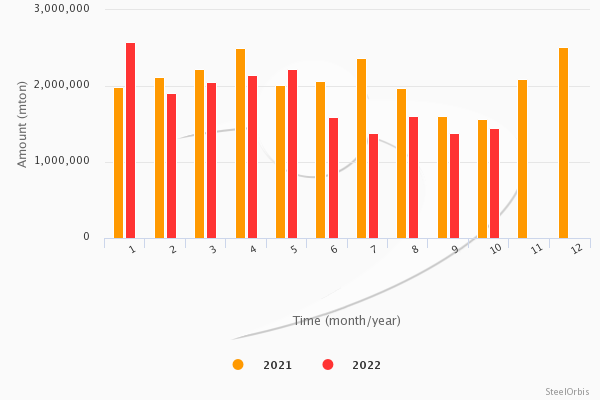
According to the data for the first ten months of the current year, the leading scrap supplier to Turkey was once again the EU, which accounted for 59 percent of Turkey’s imports, a total of 10,779,589 mt. Meanwhile, Turkey bought a total of 3,526,280 mt of scrap from the US in this period.
Despite the gloomy picture seen at the end of the year, Turkey’s import scrap market had started 2022 on a positive note. Prices were increasing during the January-late February period, with expectations of a relatively stable trend from there on. However, Russia’s invasion of Ukraine on February 24 caused significant changes in the international markets.
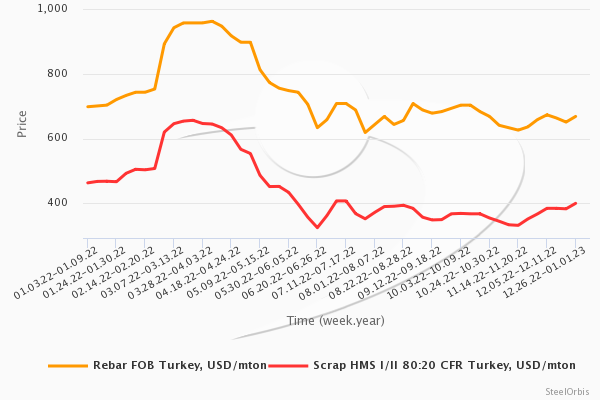
Turkish mills rushed to secure deep sea scrap cargoes, since short sea scrap flow to Turkey was compromised by the invasion. Turkey also started to receive billet demand from the export markets as Ukrainian mills announced force majeure. Opening the year at $464/mt CFR, benchmark HMS I/II 80:20 scrap quotations quickly breached the $500/mt CFR threshold in the second half of February, jumping in several steps from there to $658/mt CFR on average at the end of March. This was the peak reached by deep sea scrap prices in Turkey in 2022.
The reason for the price increase was Turkey’s potential to fill the gap left by Russia and Ukraine, and this impression was supported by the first wave of demand received by Turkey from various markets. In the third week of March, market players believed that scrap prices were rising due to the large number of finished steel sales booked by Turkish mills, though their finished steel export sales were not so lively looking at the tonnages in question, despite the high number of deals. Eventually, the finished steel tonnages sold were insufficient to support increases in scrap quotations.
Turkey had not initiated any sanctions against Russia and, despite the lack of any barriers on the Russian side against scrap exports apart from the €100/mt export duty initiated before the invasion of Ukraine, it was not easy to maintain the flow of money between the countries. The problem was not so much in payments between Turkey and Russia, but in the fact that all the established working schemes included European traders and European banks. And there was also a problem with vessels: ships were unwilling to go to Russian ports, since most of them are also restricted by sanctions. As a result, Turkey’s chances of importing scrap from St. Petersburg became close to zero.
At the end of March, there was a pressure building on Turkish semi-finished and finished steel prices against the backdrop of lower-priced imports, mainly due to the billet offers received from India and China. It was observed that Turkish mills were trying to maintain a $300/mt gap for scrap-to-rebar conversion because of their rising input costs. Another big problem was caused by Turkey’s finished steel sales. Turkish mills were struggling to find export opportunities and the anticipated recovery of the domestic construction sector did not fully materialize.
Benchmark scrap quotations for Turkey started a sharp declining trend at the end of March, with prices falling to $325/mt CFR on average by late June. This was the bottom level recorded by HMS I/II 80:20 scrap quotations in 2022. While the panic after Russia’s invasion of Ukraine caused all prices to move up sharply, with alternative suppliers and routes being created the panic in the international steel market eventually eased.
After prices had hit bottom levels in June, the fluctuations observed in the deep sea scrap market narrowed subsequently. However, the international economic slowdown, the energy crisis and the negative expectations of market players caused Turkish mills to lower their capacity utilization rates starting from June. The hike in energy prices ended up diminishing Turkish producers’ competitiveness in many export markets, added to the protectionist measures already in place. The vulnerable economic situation in Turkey did not help, with local steel demand also failing to meet expectations, or with the traditional trends observed in previous years also absent. Having come under pressure from the depreciating Turkish lira, Turkey was observed to be occasionally isolated from the international scrap market and from global sentiment. On January 2, 2022, the Turkish lira-US dollar exchange rate was at 13.31, while on January 2, 2023 the exchange rate was at 18.72. It should also be recalled that the exchange rate was at 7.43 at the beginning of 2020.
It was clearly seen towards the end of the year that, despite Turkish mills’ efforts to exert pressure on quotations by staying out of the market, most of the time scrap prices did not decline to steelmakers’ desired levels. Slowing manufacturing sectors across the world and rising inflation rates led to a decrease in scrap supply. Below the average of $349/mt CFR, all the other markets were at parity with Turkey in terms of price. Alternative markets provided support for scrap prices, not just in Asia but also in the Indian subcontinent. More than once scrap sellers stated that they did not have enough cargoes on hand to cover the desired delivery terms Turkish mills were seeking. In these circumstances, the contraction on the supply side was deeper than the contraction on the demand side. The year was closed with HMS I/II 80:20 scrap prices for Turkey at $400.5/mt CFR.