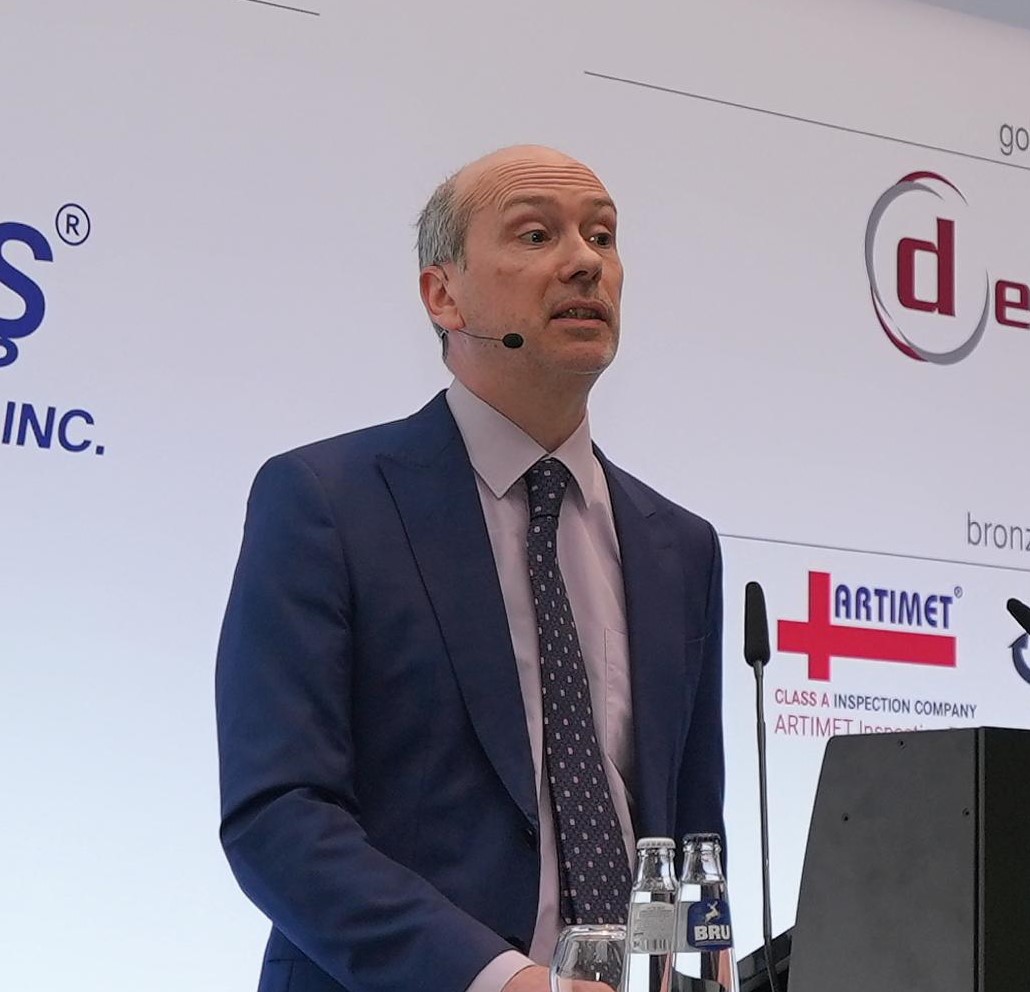
Speaking at the SteelOrbis Spring 2026 Conference & 94th IREPAS Meeting taking place in Amsterdam on April 26-28, Patrice Ollivaud, economist at the Organisation for Economic Co-operation and Development (OECD), presented the OECD’s latest interim economic outlook, highlighting increasing downside risks to global growth amid geopolitical tensions and rising energy costs.
Mr. Ollivaud stated that the recent escalation of the conflict in the Middle East has become a key driver of global economic uncertainty, primarily through its impact on energy markets. He noted that energy prices, including crude oil, oil products and gas, have recorded sharp increases, largely due to limited spare capacity among producers, which has prevented them from compensating for supply disruptions. This has resulted in rising production costs and accelerating inflation globally.
He emphasized that the Strait of Hormuz remains a critical chokepoint for global energy trade, accounting for two fifths of oil and gas flows. Ongoing disruptions have severely restricted maritime traffic, leading to supply backlogs, while commercial flights, although partially recovering, remain well below pre-conflict levels.
According to Mr. Ollivaud, the impact of the conflict extends beyond energy, affecting a broad range of commodities and further fueling inflationary pressures. He noted that inflation has accelerated following the escalation, while financial conditions have tightened, despite remaining relatively supportive overall. At the same time, early indicators such as the global purchasing managers’ index point to a clear loss of economic momentum, with recent data showing a marked slowdown.
Revisions in growth projections
Mr. Ollivaud also pointed out that the latest OECD projections indicate some revisions in growth expectations for several major economies compared to the previous outlook. In particular, the euro area outlook for 2026 has been revised down with an expected growth of 0.8 percent in 2026 and 1.2 percent in 2027, while US growth projections have been adjusted higher, now pointing to a 2 percent growth in 2026 and 1.7 percent in 2027. The global GDP growth projections stand at 2.9 percent for 2026 and 3 percent for 2027.
On the other hand, labor markets have remained broadly stable so far, with limited changes observed prior to the escalation of the conflict. Mr. Ollivaud also noted that there are currently limited signs of artificial intelligence displacing jobs, even though AI-related production, trade and investment have been increasing rapidly, supported by strong capital expenditure pipelines.
Commenting on regional developments, he stated that China has continued to rely on trade as a key growth driver, supported by strong export performance, although the ongoing contraction in the real estate sector is expected to persist in the near term. He added that AI-related activities have supported industrial production in China, while inflation has started to rise from previously low levels.
Looking ahead, Mr. Ollivaud warned that a further increase in energy prices could significantly weigh on both growth and inflation. While futures markets suggest that the recent spike in oil prices may be relatively short-lived, he stressed that prolonged disruptions and additional trade restrictions would continue to pose significant risks to the global economic outlook.