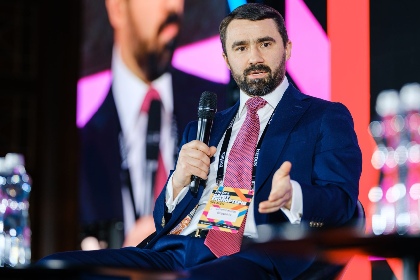
Oleksandr Vodoviz, head of the CEO office at Ukrainian miner and steel producer Metinvest Group, has outlined the key challenges facing Ukrainian steel exports to the EU during the Forbes Ukraine Exporters Summit in Kyiv, pointing to the combined impact of the EU’s Carbon Border Adjustment Mechanism (CBAM), rising production costs and geopolitical factors.
Despite significant capacity losses since 2022 due to the war and disruptions in the Donetsk region, Metinvest remains one of Ukraine’s largest exporters. Europe continues to be its main steel market, alongside the Middle East and North Africa, while its iron ore exports are primarily directed to China.
CBAM and political factors limit competitiveness
According to Vodoviz, Ukrainian steelmakers have undergone modernization and are capable of competing with European producers on costs. However, political considerations within the EU often limit fair competition, particularly in sectors with high employment sensitivity.
The implementation of CBAM has introduced additional costs for carbon-intensive products, reducing Ukraine’s competitiveness. Vodoviz stated that CBAM functions not only as a climate policy tool but also as a mechanism that effectively protects European industry, forcing Ukrainian suppliers to scale back exports.
Russian steel and dumping concerns intensify pressure
Another major challenge is the continued presence of Russian steel in the EU market, often offered at dumping prices. This situation further weakens the position of Ukrainian exporters, adding to the cost pressures already created by CBAM and operational challenges.
Cost disadvantages and limited state support
Taras Kachka, deputy prime minister for European and Euro-Atlantic Integration, emphasized that the metallurgy sector is highly politicized and subject to tariffs, restrictions and complex regulations.
He noted that, while the EU has removed several trade barriers for Ukrainian steel since 2022, European producers continue to benefit from long-term decarbonization support and subsidies, unlike Ukrainian companies.
Vodoviz highlighted that the lack of state-backed decarbonization funding in Ukraine has significantly increased cost pressures, particularly amid high electricity prices, tariffs and wartime disruptions. In contrast, European steelmakers typically receive subsidies in the range of €0.8-1 billion, strengthening their competitive position.
International footprint supports market access
Despite these challenges, Metinvest maintains a competitive position through its international operations across Bulgaria, Italy, the United Kingdom, Romania and Poland.
Italy was highlighted as a key market, where local assets and established customer relationships provide strategic advantages, helping the company navigate current market conditions and sustain its presence in Europe.