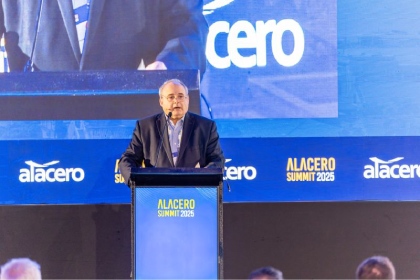
Speaking at the Alacero Summit 2025, John Lichtenstein, managing partner at World Steel Dynamics, analyzed how China’s steel exports have increasingly shifted from direct shipments to indirect exports embedded in manufactured goods.
According to Lichtenstein, indirect steel exports have exceeded direct exports every year since 2017. This transition followed the sharp surge in direct Chinese steel exports in 2014-15, which triggered global concern over excess capacity and subsidization and became a priority issue on the G7 agenda in Tokyo. Subsequent policy pressure led to a decline in direct exports and a rapid expansion of indirect flows.
Automotive emerges as key sector
From a sectoral perspective, automotive products stand out as the fastest-growing destination for China’s indirect steel exports. The share of automotive in China’s indirect steel exports increased from nine percent to 19 percent, while the “all other” category, typically lower-value steel-containing products, fell from 59 percent to 37 percent.
This shift confirms that China is moving up the value chain in its indirect steel exports. Although official data for 2025 are not yet available, Lichtenstein noted that the automotive share has likely already exceeded 20 percent and may be approaching 25 percent.
Mechanical machinery exports have also expanded. While these higher-value products can displace domestic equipment manufacturers and weaken local steel consumption, they can also serve as productive capital assets supporting industrial growth, depending on their application.
Latin America becomes fastest-growing destination
Regionally, Latin America’s share of China’s indirect steel exports rose from four percent to nine percent by 2023, making it the fastest-growing destination outside Russia. The spike in exports to Russia reflects exceptional wartime conditions following Russia’s post-invasion shift toward a war economy.
By contrast, the combined share of the US and EU declined from nearly 50 percent to around 25-30 percent.
Direct versus indirect flows into Latin America
Despite the growth in indirect exports, China’s direct steel exports to Latin America still exceed indirect exports, though both surged sharply after the pandemic. Prior to 2020, both flows were relatively stable, with the post-pandemic period marking a decisive acceleration.
By 2023, China accounted for nearly 50 percent of Latin America’s indirect steel imports, up from 16 percent. Excluding Mexico, China’s share rises further, from 20 percent to almost 65 percent. Mexico’s lower share reflects its tight supply-chain integration with the US, even though it remains the single largest destination for Chinese indirect exports.
Automotive share higher in Latin America than globally
Comparing 2010 with 2023, China’s indirect steel exports to Latin America show a consistently higher automotive share than exports to the rest of the world. In 2023, automotive products represented around 19 percent globally, but approximately 25 percent in Latin America. Importantly, the automotive category includes not only finished vehicles, but also parts and components, many of which are flat steel-intensive.
Manufacturing value added remains stagnant
To assess the broader impact, Lichtenstein focused on manufacturing value added (MVA), which measures the economic value created through industrial processing. On a constant 2015-dollar basis, Latin America’s MVA has shown virtually no growth over the period analyzed.
At the same time, China’s indirect exports into the region have increased sharply. While correlation does not prove causation, Lichtenstein stated that Chinese indirect steel exports are clearly a major contributing factor to the stagnation of regional manufacturing.
Chinese FDI does not support steel demand
Chinese outbound foreign direct investment into Latin America has increasingly targeted the automotive sector. However, a 2024 study of the 12 largest Chinese investments in Mexico’s automotive parts industry found that most projects focused on aluminum castings and electronics, rather than steel-intensive activities. This suggests that, while production is being localized, it is not supporting domestic steel demand, reinforcing the pressure from indirect imports.
Lichtenstein concluded that the threat posed by China’s indirect steel exports to Latin America is large and growing, making continuous monitoring essential. He emphasized that sector and product mix matters, particularly whether imports take the form of components, finished goods, or productive capital assets, as these distinctions determine their long-term impact on domestic steel consumption and manufacturing resilience.