ArcelorMittal Spain has announced that its R&D team is developing an advanced system to upgrade scrap quality through mechanical friction processing under a project named FRICHATEAF. The initiative is funded within the framework of Spain’s Strategic Project for Economic Recovery and Transformation (PERTE) and is aligned with the company’s operational priorities and decarbonisation strategy.
The project focuses on industrial research and technological development aimed at improving the quality of low-grade scrap that is currently difficult to use in steelmaking. By applying friction-based mechanical technologies, FRICHATEAF enables the on-site treatment of fragmented ferrous materials, allowing them to be used more efficiently in electric arc furnaces and reducing dependence on primary raw materials such as iron ore.
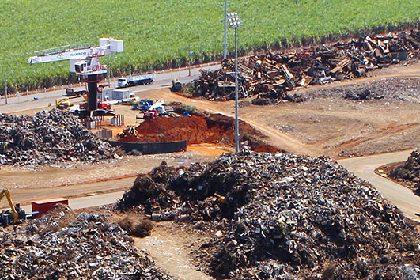
Improving EAF efficiency and environmental performance
According to ArcelorMittal Spain, the project seeks to significantly enhance scrap quality in order to improve melting efficiency in electric arc furnaces, lower energy consumption and reduce waste generation. These improvements are expected to translate into lower carbon emissions and improved operational performance, reinforcing the role of scrap as a cornerstone raw material in low-carbon steelmaking routes.
A key feature of the FRICHATEAF technology is its ability to separate and recover undesirable elements contained in scrap, including copper, aluminum, chromium and organic materials. These recovered fractions can then be redirected to other industrial applications, further strengthening resource efficiency and circularity.
Supporting circular economy and raw material security
Overall, FRICHATEAF represents a strategic step by ArcelorMittal Spain to strengthen circular economy practices in steelmaking by converting low-value scrap into higher-quality raw materials suitable for EAF production. The project is intended to support the competitiveness of European steel producers, reduce exposure to constraints on traditional raw material supply, and contribute to the broader decarbonisation of the steel value chain.