Speaking at the 20th SteelOrbis ‘New Horizons in Steel Markets’ Conference held in Istanbul on Tuesday, December 9, Dr. Veysel Yayan, secretary general of the Turkish Steel Producers Association (TÇÜD), shared with participants the current state of the Turkish steel sector and the expectations for the coming period, considering the challenges posed by protectionist measures in the global market.
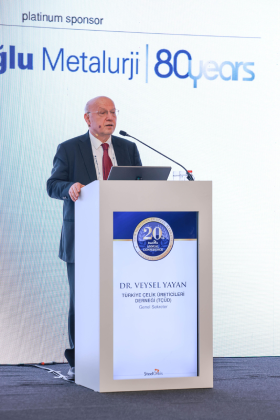
According to data shared by Dr. Yayan, there has been a systematic decline in global crude steel production since 2021. As a result, production in 2025 is expected to fall to 1.80 billion mt, compared to 1.84 billion mt in 2024. China's crude steel production alone is expected to fall to 982 million mt, following last year's figure of 1 million mt. Looking at the first 10 months this year, global crude steel production stood at 1.52 billion metric mt, a 2.1 percent decrease year on year, while Turkey's crude steel production increased by 1.2 percent to 31.3 million metric mt, rising from eighth to seventh place in the global rankings. According to Yayan, what stands out in this picture is that the production gap between Turkey and South Korea and Russia has narrowed by 3 million mt and 4 million mt, respectively. He commented, "Gaps that seem unbridgeable can be bridged within a few years. To achieve this, it is vitally important that we can meet our needs domestically. Domestic consumption is the most important instrument in the growth of our steel sector. Turkey's final product consumption is expected to reach 39.3 million mt in 2025, with a year-on-year increase of 2.6 percent." However, he stated that, despite the Turkish steel sector's advantageous position compared to other large-scale producers due to its consumption potential, it has been unable to capitalize on this.
Capacity utilization rates in Turkish steel sector must be increased
Yayan shared with conference participants his view of the Turkish economy and its many sectors, and their impact on the steel market. In the first nine months this year, the Turkish economy grew by 3.7 percent, the construction sector by 11.3 percent and the manufacturing sector by 3.9 percent, while the steel sector showed only one percent growth compared to 9.4 percent in 2024. Noting that the Turkish steel sector has been volatile compared to the global steel sector, he stated, "There has been growth in Turkey's gross domestic product for the last 20 quarters. However, there is also a negative factor in this development, namely, there has been a revival in the construction sector following the 2023 earthquake. The growth in our manufacturing industry is not at the rate we expected. In particular, we see that around 200 companies in the textile sector have moved their production to Egypt. In the steel sector, growth has been two steps forward, one step back. This imbalance stems not only from fluctuations in our domestic market but also from global developments." He pointed out that the sector's ability to remain afloat despite these fluctuations indicates its strong structure, but emphasized that this should not be seen as something to be proud of, but rather as a negative factor that should not be ignored. According to the TÇÜD data, capacity utilization rates in the sector are still below 70 percent, which is considered to be a “reasonable” level, while Yayan said he believes this must be increased.
Increased steel consumption makes Turkey a target for other countries
The TÇÜD secretary general commented on the TÇÜD data he shared with the conference participants. Stating that Turkey's final product consumption is expected to reach 39.3 million mt in 2025 with a 2.6 percent increase, he said, "The increase in steel consumption is making Turkey a target for countries experiencing a decline in local consumption. In fact, exports from Russia and China have increased significantly. We can also view shipments from the Far East as indirect exports from China." He stated that China has not imposed any restrictions on its crude steel production and that Chinese steel producers continue to export despite suffering losses, thanks to state support, in order to protect employment.
Extra costs make producers' work difficult
The TÇÜD official stated that the system of equal and fair free trade in the global market is a thing of the past. He noted that European countries announce new protective measures every week and that steel prices are $180-200/mt higher than in Turkey, while the US continues its protectionist stance. He also emphasized that there is a heavy burden on producers in Turkey, saying, "It's as if we were making profits like the US, and the government is implementing measures that require us to raise prices. Renewable Energy Resources Support Mechanism costs, Rebar Tracking System service fee and the environmental contribution payments remain a significant burden for the industry. The environmental contribution fee we have been paying for 18 years is around $60-70 million per year, and, moreover, there is no such thing as state aid in our country," he said.
Outlining his expectations for the coming period, Yayan stated that the slowdown in the global market and the contraction in local demand could lead to a decline in Turkey's crude steel production. Furthermore, growth in manufacturing sectors such as automotive is expected to support steel consumption in the coming period. Nevertheless, the fact that Turkey, which has been a net steel importer for the past few years, continues to increase its imports despite having sufficient installed capacity, creates a worrying picture.