Speaking at the Eurometal Steel Day & 11th YISAD Flat Steel Conference held at Istanbul Marriott Hotel Asia on Tuesday, March 24, in cooperation with SteelOrbis, Tolga Yalgı, CEO of Turkish steel producer Tatmetal, addressed developments in the global market and Tatmetal’s investments.
Stating that the balances established after the Second World War have shifted, giving rise to a new geopolitical and economic order, Mr. Yalgı noted that, in this new system, a model has emerged in which the market is guided by governments instead of free market dynamics, and strategic sectors are protected. Emphasizing that this transformation has fundamentally changed the rules of competition, he added that competition is no longer between companies, but between countries’ industrial policies.
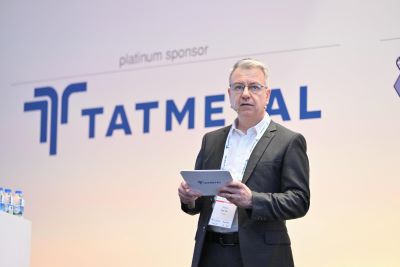
He noted that the US is pursuing a strong reindustrialization policy aimed at bringing production back within its borders, with the support of trade policies to reduce dependency in critical sectors. Pointing out that China’s approximate 30 percent share in global production significantly affects market balances, Mr. Yalgı noted that China’s high capacity creates structural pressure not only through price competition but also through global oversupply. Meanwhile, the European Union is reshaping its industrial policy through mechanisms such as carbon regulations, the emissions trading system, and the Carbon Border Adjustment Mechanism. According to Yalgı, this approach indicates that production is being redefined not only by costs but also by environmental criteria.
European market remains critical for Turkey
While the European market continues to play a decisive role in Turkey’s steel exports, factors such as geographical proximity, logistical advantages and the Customs Union Agreement provide significant competitive advantages. Mr. Yalgı stated that Turkey stands out with its fast delivery capabilities and electric arc furnace-based production, adding that existing trade relations offer a strong foundation for the Turkish steel industry. However, he warned that the EU’s protectionist measures pose the greatest risks, particularly planned quota reductions and higher tariff applications set to take effect as of June 30, 2026, which could directly impact Turkey’s exports.
Energy and geopolitical risks come to the forefront
Highlighting that rising geopolitical risks in the Middle East are creating upward pressure on energy costs and supply chains, Yalgı noted that increases in energy prices and potential logistical disruptions could affect production continuity, making energy supply security a strategic issue for the sector.
Tatmetal’s position
Concluding his remarks, Yalgı outlined Tatmetal’s position and investments, stating that the company, with an annual production capacity of 1.5 million mt, exports to 80 countries across six continents. He added that renewable energy investments are among the company’s strategic priorities, noting that solar power plants with a total installed capacity of 110,000 MWp are expected to generate 176,000 MWh of electricity in 2026, while wind power plants with a total installed capacity of 66 MWm are expected to produce 220,000 MWh annually.