According to data released by the Australian Bureau of Statistics, Australia’s mineral exploration expenditure rose by 16.3 percent year on year to A$949.3 million in the March quarter, while the mining industry warned that a planned change to the capital gains tax regime could weigh on investor appetite in the coming quarters.
Industry warns of impact from tax proposal
According to S&P Global, The Association of Mining and Exploration Companies (AMEC) stated that the full impact of the Australian federal government’s proposed capital gains tax changes, announced in the fiscal year 2026-27 budget, has not yet been reflected in the data, but may become visible in future quarterly figures as investors reassess the risks of financing early-stage exploration projects. On May 12, the government proposed replacing the 50 percent capital gains tax discount with cost base indexation for shares held by individuals, trusts and partnerships for more than 12 months, effective July 1, 2027.
Warren Pearce, CEO of AMEC, said that companies had continued drilling amid strong commodity prices and global demand for Australian resources, but added that the next quarter’s figures would be the real test, as the federal budget and the planned capital gains tax changes begin to affect investment decisions. AMEC also said some companies have already started pausing their next steps, including initial public offerings and drilling programs, adding that smaller exploration companies rely heavily on retail investors to fund their activities.
Western Australia leads state-by-state growth
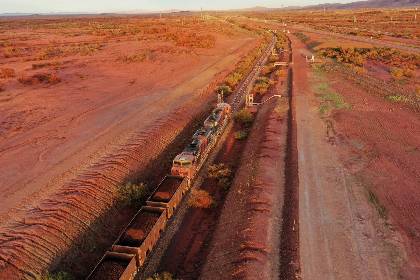
On a state basis, Western Australia recorded a 25.3 percent year-on-year increase in mineral exploration spending to A$681.3 million in the March quarter, supported by its key role in Australia’s gold, lithium and iron ore sectors, while the state’s Pilbara region remains central to the activities of major iron ore producers such as Rio Tinto, BHP and Fortescue.
Rio Tinto and BHP have also been evaluating cooperation opportunities at neighboring Pilbara iron ore operations, including the potential extraction of up to 200 million mt of iron ore from assets around the Yandicoogina and Yandi operations, showing that Western Australia continues to attract investment aimed at extending mine life and improving operational efficiency.
In South Australia, Iron Road continues to own the Central Eyre Iron Project, an advanced magnetite iron ore project on the Eyre Peninsula, while the future of the Whyalla steelworks and related magnetite resources remains an important part of the state’s ferrous raw materials outlook.
Queensland’s mineral exploration spending declined by 19 percent year on year to A$84.9 million, though the state remains one of Australia’s key metallurgical coal regions through the Bowen Basin, where BHP Mitsubishi Alliance operates major coal mines and supplies seaborne coking coal to the global steel industry.
In New South Wales, where exploration spending rose by 25.7 percent year on year to A$72.3 million, coal producer Whitehaven Coal remains one of the key ferrous raw material-linked companies operating in the state, with its coal assets continuing to support Australia’s export-oriented coal sector.