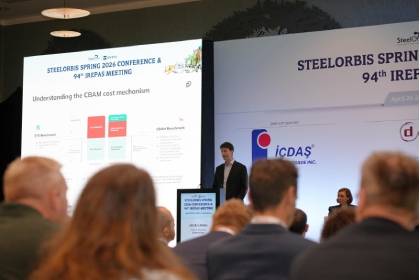
Speaking at the second session of the SteelOrbis 2026 Spring Conference & 94th IREPAS Meeting, Jack Laing, carbon specialist at UK-based carbon accounting platform CarbonChain, made a presentation regarding the EU Carbon Border Adjustment Mechanism (CBAM).
Mr. Laing stated that the definitive phase of CBAM, which began on January 1, 2026, has transformed the mechanism from a reporting exercise into a financial mechanism for importers. CBAM costs are now actively accruing, and importers must account for these costs throughout 2026, as failure to do so shifts the financial burden elsewhere in the supply chain.
Default values significantly increase costs
The CarbonChain official highlighted a key element which is the significant cost difference between default values and verified actual emissions data. Default values, which are based on EU-published average emissions by product (CN code), production route and country, are designed to be often punitive. He stated that the gap between default and actual emissions can reach two to four times higher costs, particularly for products sourced from countries such as China, India and South Africa.
The CBAM cost mechanism is structured to mirror the EU Emissions Trading System (ETS), with the objective of ensuring a level playing field. Emissions above benchmark levels are fully subject to CBAM charges, and benchmarks decrease annually in line with the phase-out of free ETS allowances. As a result, cost exposure begins from the first year and increases overtime.
He provided an example that showed a steel re-roller installation with an emissions intensity of 1.343 tCO₂/t compared to a benchmark of 0.782 tCO₂/t, resulting in a calculated cost of approximately €46.42 per ton, assuming an ETS price of €80/t.
Tight compliance timeline
Mr. Laing stated that the compliance timeline is clearly defined. For the 2026 monitoring year, operators must collect emissions data throughout the year, prepare emissions reports in the first quarter of 2027, and obtain third-party verification by the second quarter of 2027. Importers must begin purchasing CBAM certificates from February 1, 2027, with certificate prices based on the quarterly average ETS price. The final deadline for submitting CBAM declarations and surrendering certificates for 2026 emissions is September 30, 2027.
From 2027 onward, importers must comply with a quarterly obligation to hold CBAM certificates covering at least 50 percent of embedded emissions, increasing compliance complexity. He noted that no certificate purchases are required during 2026 due to transitional provisions, but financial obligations begin in 2027.
He also highlighted the distribution of responsibilities across the value chain. Producers are responsible for generating installation-level emissions data, while importers (declarants) are responsible for reporting and purchasing certificates. This creates a dependency, as importers rely on verified data from upstream producers, making verification capacity a potential bottleneck in 2027.
Uneven country-level impact
Country-level impacts vary significantly. Turkey, as the largest exporter of long products to the EU with an EAF-dominant production route, may benefit from relatively lower emissions intensity, though uncertainties remain regarding carbon pricing deductions. India faces complexity due to mixed production routes and precursor chains. Egypt and CIS countries are exposed to full CBAM costs due to the absence of recognized carbon pricing systems. China, with BF-BOF dominance and high coal dependency, shows some of the highest embedded emissions globally, while Vietnam faces exposure through growing EAF-based production using imported scrap.
CBAM is expected to expand to include indirect emissions (Scope 2), increasing cost exposure for electricity-intensive production. The product scope is projected to widen to downstream goods such as screws, tubes and wire products, potentially covering around 180 additional product categories and 7,500 importers by 2028.
Dual compliance with UK CBAM
Laing said that, in parallel, the UK CBAM is set to enter into force on January 1, 2027, introducing a separate regulatory framework and requiring dual compliance for exporters targeting both EU and UK markets. Key elements include sector coverage (iron and steel, aluminum, cement, fertilizers, hydrogen), a £50,000 annual threshold, and quarterly CBAM rates linked to the UK ETS.
He concluded that CBAM cost exposure is already material and increasing, with the difference between default and verified emissions data translating into millions of euros in potential cost impact. At the same time, upcoming regulatory changes, including scope expansion and verification requirements, are expected to increase compliance complexity across the steel value chain.