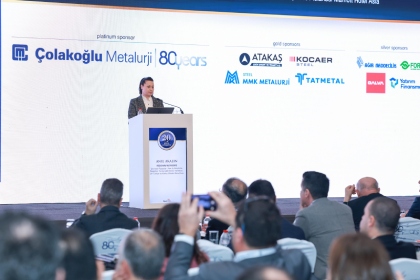
At the 20th SteelOrbis New Horizons in Steel Markets Conference held on Tuesday, December 9, in Istanbul, Anıl Akalın, director of new business development, head of renewable energy, CP Turkey and GCC at UK-based consulting company Redshaw Advisors, presented an in-depth overview of the EU Carbon Border Adjustment Mechanism (CBAM) and its implications for industrial exporters, particularly within the steel sector.
Ms. Akalın began by positioning carbon markets within the broader framework of emissions reduction instruments. She said carbon mitigation today is driven by four principal mechanisms: direct regulation, carbon taxation, cap-and-trade systems such as the EU Emissions Trading System (EU ETS), and voluntary carbon offsetting. Companies engage in these markets either to comply with binding regulatory requirements or to meet voluntary sustainability commitments, she stated.
CBAM set to replace free allocations as leakage shield
A substantial part of the briefing focused on the EU ETS, which forms the price backbone of CBAM. EU allowances (EUAs), used to cover one metric ton of carbon emissions, are auctioned frequently, can be freely traded and do not expire. In recent years, EUA prices have risen markedly as a consequence of tightening emission caps, energy market disruptions following the Russia-Ukraine conflict, and additional demand created by sectors newly brought into the system. This tightening trajectory is expected to continue, supporting higher carbon prices in the medium term.
Ms. Akalın said CBAM is intended to safeguard the integrity of the EU ETS by preventing carbon leakage - situations where carbon-intensive production relocates to jurisdictions with weaker regulations and then re-enters the EU as imported goods. As free allocation to EU producers is phased down, CBAM will ensure that imported goods face an equivalent carbon price. The mechanism requires importers of covered goods to be authorized, calculate the embedded emissions of their imports, submit verified data, and purchase CBAM certificates reflecting the carbon cost that would have applied had the goods been produced within the EU.
The implementation timeline extends from late 2025 through the full operationalization of CBAM in 2034. The first certificates will become available shortly before the start of the definitive period on January 1, 2026. Ms. Akalın highlighted that, even though certificates are currently not available, there are financial obligations for 2026, and their payments have been delayed to 2027. Importers must accumulate certificates throughout the year and meet holding requirements by March 2027, with the first surrender deadline set for September 2027. Certificate prices will initially reflect quarterly averages of EU ETS auction prices, later transitioning to weekly averages. Further scope expansion, including the likely inclusion of downstream steel products, is expected by 2030.
Price formation under CBAM closely follows EU ETS dynamics. Rising EUA prices, driven by stricter caps, the inclusion of maritime transport in 2027 and a reduction in additional REPowerEU auction supply, will directly translate into higher CBAM certificate values. This creates a cost exposure for exporters to the EU, particularly in sectors with high carbon intensity.
Export-dependent economies face heightened risks
The Redshaw Advisors official then examined global trade implications. Based on independent analyzes, Akalın underlined that economies heavily engaged in exporting carbon-intensive goods, such as China, Turkey, India, the UK and Russia, are among the most affected. CBAM is estimated to apply to only a small share of total EU imports but is highly concentrated in steel, aluminum, cement and fertilizers. Concerns were noted about “resource shuffling”, whereby exporters route their lowest-emission production batches to CBAM markets while allocating higher-emission output elsewhere.
Turkey, as a major supplier of steel and aluminum to the EU, was highlighted in detail. Based on projected embedded-emission factors and expected 2030 and 2034 certificate prices, Turkey’s steel exports to the EU could decline by two to three percent by 2032, Turkey’s CBAM-related costs could potentially rise to €771 million in 2026 and then to €2.5 billion by 2032, while Turkey’s steel exports could face additional costs of 11 percent of product prices by 2026. Therefore, CBAM could impose significant annual costs on Turkish exporters unless emissions measurement and reporting systems are strengthened.
Emphasizing the importance of accurate emissions data, domestic carbon-pricing recognition, and strategies to mitigate certificate-price volatility, Ms. Akalın pointed out that early preparation is critical to minimizing the risks that may arise under CBAM. She stated that companies can adapt to the process by focusing particularly on verified measurement methods and emission data, which will become mandatory as of 2026. In this way, both financial obligations can be planned in advance and measures can be taken against market volatility. Within the scope of financial risk management and hedging mechanisms, she recommended the use of various instruments that allow companies seeking to stabilize their costs to take forward positions. This would enable sectors covered by CBAM to lock in the cost of CBAM certificates today, protecting themselves against price fluctuations and gaining a competitive advantage. She concluded by noting that companies that do not take action now will face significantly high total costs during the 2026-30 period, whereas these costs can be substantially reduced by between 40 percent and 65 percent through the use of hedging strategies. Therefore, she concluded, hedging mechanisms are required for companies in order to secure price protection against future CBAM liabilities.